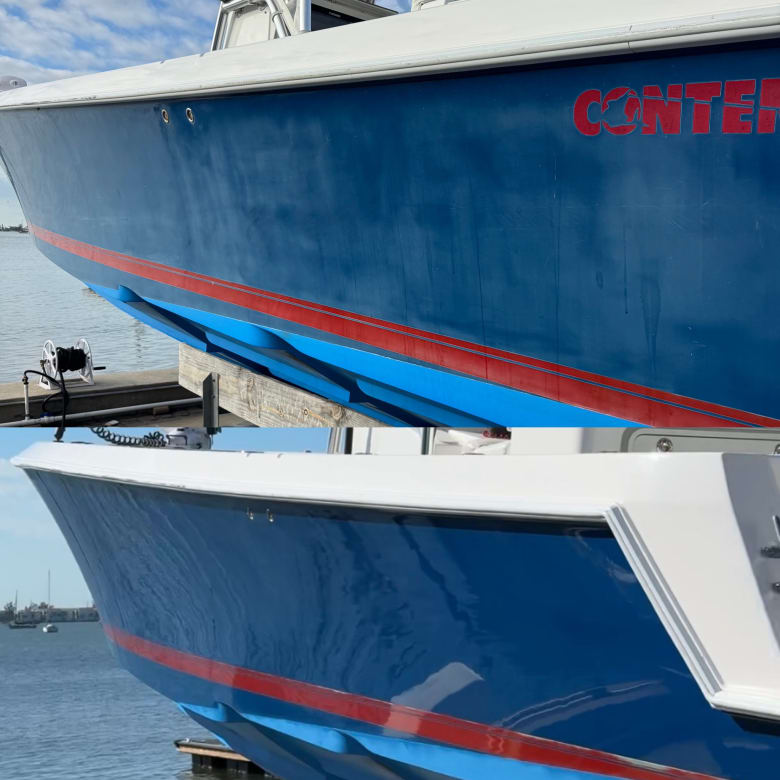
Oxidation is the most common and most misunderstood problem affecting boats in Florida. Most boat owners notice it when their hull starts looking chalky and dull — but by that point, the process has been underway for months or even years. Understanding what it is, why it happens faster here than anywhere else, and what the correct treatment looks like can save you from a much more expensive problem down the road.
What Exactly Is Gelcoat Oxidation?
Gelcoat is the outer protective layer of a fiberglass boat hull. It's a polyester resin that provides both the color and the first line of defense against the elements. When gelcoat oxidizes, the UV radiation and oxygen in the atmosphere break down the polymer chains in this outer layer. The result is a chalky, degraded surface that has lost its gloss, its color depth, and its ability to shed water effectively.
Think of it like sunburn on skin — except the gelcoat can't heal itself. Once the damage is done, the degraded layer has to be physically removed and the surface below it revealed and protected.
Why Florida Accelerates Oxidation
Florida receives an average UV index of 10–12 during summer months — classified as "extreme" by the World Health Organization. Compare that to a UV index of 5–6 in the Pacific Northwest or the Midwest. UV is the single biggest driver of gelcoat oxidation, which means a boat kept in Florida for one year is aging roughly twice as fast as the same boat kept further north.
Heat compounds the problem. UV damage accelerates with temperature, so Florida's combination of high UV and high ambient temperature creates a particularly aggressive environment. Add constant saltwater exposure — which strips protective wax and sealants faster than freshwater — and you have conditions that make proactive maintenance not just advisable but essential.
How to Identify the Severity of Oxidation
Not all oxidation is the same. The level of degradation determines what treatment is required and whether restoration is still possible.
| Severity | Appearance | Treatment |
|---|---|---|
| Light | Slight dulling, reduced gloss, water no longer beads well | Machine polish + wax |
| Moderate | Noticeably faded color, chalky residue when rubbed, visible haze | Compound + polish + wax or ceramic |
| Heavy | Significant color loss, powdery chalking, rough texture | Aggressive compound stages + polish + protection |
| Severe | Deep color loss, surface pitting, structural degradation of gelcoat | Respray may be necessary — consult a professional |
The good news: light, moderate, and most heavy oxidation is fully restorable through machine compounding and polishing. Severe oxidation — where the gelcoat has thinned to the point of transparency or pitting — may require professional respray, which is significantly more expensive.
The Correct Treatment Process
Wax does not fix oxidation. This is the most common misconception we encounter. Wax is a protective coating — it works on a clean, intact surface. Applying wax over an oxidized hull is like painting over rust. The underlying problem remains and continues to worsen.
Correct oxidation treatment follows this sequence:
- Decontamination wash — removes salt, algae, grime, and surface contamination
- Clay bar treatment — pulls embedded contaminants the wash leaves behind
- Machine compounding — uses an abrasive compound with an orbital or rotary polisher to remove the oxidized gelcoat layer
- Machine polishing — refines the surface left by the compound, removes micro-scratches, restores clarity and depth
- Protection application — wax (3–4 month protection) or ceramic coating (2+ year protection) seals and protects the restored surface
Need Marine Detailing in Tampa Bay?
Free estimate. We come to your dock. Same-week availability.
Get a Free EstimatePrevention: The Smarter Long-Term Play
Restoration is satisfying but preventable maintenance is better. Once you've invested in a proper oxidation removal and polish, protecting that result is significantly cheaper than restoring it again.
The options, from shortest to longest protection:
- Carnauba wax — 60–90 days in Florida conditions. Beautiful depth of shine but requires frequent reapplication.
- Synthetic polymer wax — 90–120 days. Better UV resistance than carnauba, more practical for regularly used boats.
- Marine ceramic coating — 3–5 years. Chemically bonds to the gelcoat surface. Hydrophobic, UV-resistant, and significantly reduces maintenance frequency. Higher upfront cost but dramatically lower total cost over 3 years.
For most Tampa Bay boat owners who use their vessel regularly and don't want to be on a 90-day maintenance schedule, ceramic coating is the most cost-effective long-term solution. For boats used occasionally or owned by those who enjoy regular detailing, a quality synthetic wax applied properly every 90–120 days does the job.
One Final Note on DIY vs. Professional Treatment
Light surface polishing is within the capability of a careful DIYer with the right equipment. Heavy oxidation is not. Rotary polishers and aggressive compounding on heavy oxidation require experience to avoid burning through the gelcoat — especially on corners, edges, and curved surfaces. Burning through gelcoat means respray, which costs far more than a professional detail. If your boat has anything beyond light surface oxidation, the professional route protects your asset and delivers a better result.