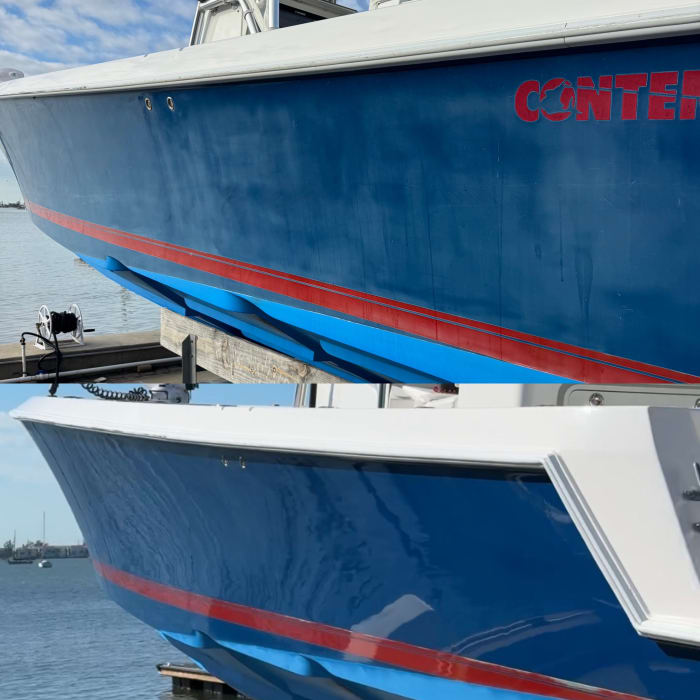
Restore faded, chalky gelcoat to a deep mirror finish. Dockside service at Harborage, Maximo, Tierra Verde, and throughout St. Pete โ we come to you.
Oxidation is the cumulative breakdown of your boat's gelcoat outer layer from UV radiation reacting with oxygen. In most parts of the country, boats oxidize slowly โ a neglected hull might show early oxidation after five or six years. In St. Petersburg, that timeline compresses dramatically. The Pinellas County UV index routinely reaches 10 to 11 during summer months, and the combination of year-round boating season, high ambient humidity, and saltwater exposure creates conditions where moderate oxidation can develop on an unprotected hull in under two years.
St. Pete's marina inventory compounds this. The majority of wet slips at Maximo Marina, Harborage Marina, and the Municipal Marina face south or west โ direct into the afternoon sun that delivers the highest daily UV dose. Boats in full-sun wet slips at these facilities are in essentially ideal conditions for accelerated oxidation: UV radiation during the day, warm humid nights that trap oxidized gelcoat products on the surface, and salt spray that acts as a mild abrasive across the finish each time the tidal wind picks up.
The result is that we see moderate to heavy oxidation on St. Pete boats regularly โ often on vessels that have been maintained but whose owners used consumer-grade products not formulated for Florida's UV intensity, or who waxed on a schedule that made sense in a northern climate but can't keep up with year-round Pinellas County conditions. The good news: in the vast majority of cases, even heavy oxidation is fully restorable without a respray.
If you're trying to diagnose your own hull before calling us, here's what to look for. Run the back of your hand firmly across the hull in direct sunlight. If you get a white or grayish transfer on your skin, you have at minimum mild oxidation โ the outer gelcoat layer has degraded enough to be releasing material. The more transfer you get, and the more the hull looks gray or chalky under direct light rather than gloss, the further along the oxidation is.
St. Pete boats in full-sun wet slips often show a pattern we see frequently: the starboard side (facing west at most marina orientations) is heavier than the port side, and the areas above the waterline near the bow โ which face the afternoon sky at a favorable angle for UV absorption โ oxidize before the transom area. If you're looking at your boat at Harborage and the forward starboard hull looks visibly duller than the port side, that's a common St. Pete pattern, not a defect in the original gelcoat.
Light chalkiness, still retaining color depth. Two-step compound + polish typically restores full gloss. Most common on St. Pete boats under five years old that missed a full detail season.
Visible color fade, rough texture, heavy chalky transfer. Machine compound required; some areas may need light sanding first. The most common scenario on Maximo and Harborage full-sun slip boats.
Deep discoloration, gray or yellow cast, possible surface crazing. Wet sanding required before compounding and polishing. Multi-step, multi-day job โ but still fully recoverable in most cases.
"My 2012 Regal at Maximo was so oxidized I almost listed it. Alex came to the dock, worked through a full wet sand and compound job, and the hull looks better than it did when I bought the boat. Unreal result."
Pricing is driven by vessel size and the number of correction steps required โ a mild two-step job costs less than a heavy four-step wet sand, compound, polish, and refinement. The ranges below reflect current Pinellas County market rates and cover the full restoration process including final sealant or ceramic protection.
| Vessel Size | Oxidation Removal Range |
|---|---|
| Under 20ft | $800โ$1,500+ |
| 20โ25ft | $1,000โ$2,000+ |
| 26โ30ft | $1,500โ$2,500+ |
| 31โ40ft | $2,000โ$3,500+ |
| 40โ50ft (Yacht) | $2,500โ$5,000+ |
| 50ft+ (Yacht) | Quoted individually |
Sending photos of the hull in direct sunlight makes a significant difference in quote accuracy. Call 813-420-5873 or book online and we'll assess the oxidation level and give you a specific number before any work begins.
Get a straight quote on your St. Pete boat. Fast response, same-week scheduling.
Every oxidation removal job starts with an honest assessment of what's actually needed โ because the correction approach that works on mild oxidation will produce a result that fades back on a moderately oxidized boat within a month. Here's how we work through it.
We inspect the full hull in direct sunlight, checking oxidation depth and consistency across all panels. Harborage and Maximo slips often have sections at different severity levels โ the starboard forward hull may be heavy while the shaded port side is only mild. Each section gets the correct treatment, not a one-size approach.
A full wash removes salt residue, biological growth, and waterline deposits before any correction work. St. Pete boats in wet slips accumulate significant biological contamination at the waterline โ this needs to be fully removed before compounding begins or it embeds into the freshly opened gelcoat.
Heavy oxidation requires wet sanding to cut below the damaged layer before compounding. Moderate oxidation goes straight to machine compounding. We use the correct product and pad combination for the gelcoat type and thickness โ thin gelcoat on older St. Pete boats requires a more measured approach than newer gelcoat with more material to work with.
After compounding, a polishing stage removes remaining micro-scratches and restores the deep wet gloss of healthy gelcoat. This is the step where the visible transformation happens โ a St. Pete boat that came in looking gray and chalky under the afternoon sun leaves with a mirror finish.
Restored gelcoat in Tampa Bay's UV environment without protection will begin oxidizing again within 12โ18 months. We apply either a polymer SiO2 sealant (3โ6 months of protection) or a full marine ceramic coating (2+ years). Most St. Pete boat owners who've been through a full restoration choose ceramic at this point โ it's the logical endpoint of the investment and prevents repeating this process annually.
In almost every case like this โ a 2015 boat in a full-sun Maximo slip โ the oxidation is fully recoverable without a respray. A 2015 model year hull has 11 years of Florida UV on it, which in a west-facing wet slip means it's likely in the heavy oxidation category: chalky gray color, rough texture, heavy white transfer when you run your hand across the surface. That's significant, but it's well within what a proper wet sand, compound, and polish sequence can reverse.
The scenario where we'd recommend a respray instead is when the gelcoat has been corrected multiple times previously and no longer has adequate thickness to safely sand โ material has to be removed during correction, and there's a finite amount of it. For a 2015 boat that's been mostly neglected rather than repeatedly polished, the gelcoat thickness is typically still workable. We'd assess that on-site before committing to a restoration. Send us photos of the hull in direct afternoon sun and we can give you an honest read on the restoration vs. respray question before you even schedule a visit.
Free estimate. Dockside service at Harborage, Maximo, Tierra Verde, and throughout Pinellas County. 45 five-star reviews.
Full menu of marine detailing we offer throughout St. Pete and Pinellas County.
View Area PageProtect your restored gelcoat. Ceramic coating applied at your St. Pete marina.
Learn MoreComplete details on our gelcoat restoration process, severity levels, and FAQ.
Learn More