Gulf Exposure and Gelcoat —
Why Clearwater Boats Oxidize Hard
Clearwater's Gulf-adjacent geography creates the most aggressive gelcoat oxidation conditions in the Tampa Bay region. The combination of direct Gulf salt aerosol from prevailing westerlies, high UV index from open-sky western exposure, and the reflected solar gain off the Gulf of Mexico's shallow white-sand water creates a surface degradation environment that consistently produces heavy oxidation on boats that would only show mild oxidation in more protected bay locations.
Boats at Clearwater Beach Marina and along the Intracoastal Waterway on Clearwater Beach itself face this at maximum intensity. The charter fleets operating out of Clearwater Beach — which run multiple trips per day with boats at full throttle in open water — accumulate oxidation faster than any other vessel category we work with in Pinellas County. A charter boat in its second or third season at Clearwater Beach without a professional restoration is typically presenting moderate to heavy oxidation across the entire hull, with the bow being the most heavily damaged from spray impact and UV during offshore runs.
The Island Estates community — the network of private docks on the barrier island channels just east of Clearwater Beach — presents a slightly different oxidation pattern. Boats there are more protected from wave impact but still fully exposed to the Gulf salt air corridor and western afternoon sun. The longer-term storage typical of private dock boats means they accumulate oxidation more evenly across the hull than frequently-used charter boats, but the total UV load is equivalent or higher given how long they sit in the sun between uses.
How Gulf Salt Accelerates Gelcoat Breakdown in Clearwater
Standard marine oxidation is primarily a UV phenomenon — the sun breaks down the polymer structure of the gelcoat surface over time. But in Gulf-adjacent locations like Clearwater Beach, airborne salt aerosol adds a second mechanism: salt particles deposited on the gelcoat surface create microscopic crystalline formations that act as abrasives with every thermal expansion and contraction cycle. Over time, this creates a surface texture rougher than UV damage alone produces, which is why Clearwater boats often present heavier tactile roughness alongside color fade compared to inner bay boats with equivalent UV exposure history.
This salt-abrasion effect means that Clearwater boats sometimes need more aggressive correction than their color fade alone would suggest. A hull that looks moderately faded may have the surface texture of heavy oxidation when you run your hand across it — the compound stage has to cut deep enough to get below the salt-roughened surface layer before polish can restore true gloss.
After any restoration on a Clearwater boat, protection is especially critical. We're more emphatic about the transition to ceramic coating after a Gulf-exposure restoration than we are for inner bay boats — the return rate of oxidation at Clearwater Beach without adequate protection is consistently faster, and repeating a full restoration annually is expensive. Ceramic coating changes that math significantly.
Clearwater Locations We Service
- Clearwater Beach Marina — Gulf-direct exposure. Charter fleet and private recreational boats. Highest UV and salt load in the Clearwater market.
- Island Estates docks — Private residential docks on the barrier island channels. Mix of powerboats and sailboats. Consistent salt air exposure with afternoon western sun.
- Clearwater Municipal Marina — Protected Clearwater Harbor location. Lower direct salt exposure than Clearwater Beach, but still significant UV load and bay salt.
- Dunedin Marina — St. Joseph Sound. Gulf passage exposure for cruising boats. Active sailing community with a range of hull materials including fiberglass, wood composite, and aluminum.
- Safety Harbor Marina — Old Tampa Bay, well-protected. Lower salt and UV compared to Gulf-side Clearwater locations, but consistent bay salt and full summer UV.
- Ozona Blue Marina and Marker 1 Marina — Ozona Bayou and Dunedin area. Recreational boating community with varied vessel ages and conditions.
- Palm Harbor and Tarpon Springs marinas — Northern Pinellas waterway access. Boats here often run through Anclote Key passes into the Gulf, with corresponding salt exposure.
Oxidation Severity on Clearwater Boats
Mild Oxidation
Light dulling, color still largely intact. Common on Clearwater boats under 3 years old or in covered storage. Two-step compound and polish restores gloss without wet sanding.
Moderate Oxidation
Visible fading, rough surface texture, heavy chalky transfer. The most common presentation for Clearwater Beach boats in their second or third season without professional restoration. Machine compounding required; some sections may need sanding prep.
Heavy Oxidation
Deep discoloration, possible crazing, yellow or gray cast. Wet sanding plus multi-step correction required. Common on charter boats and older private vessels in Gulf-side Clearwater slips. Still recoverable in most cases — not a respray situation.
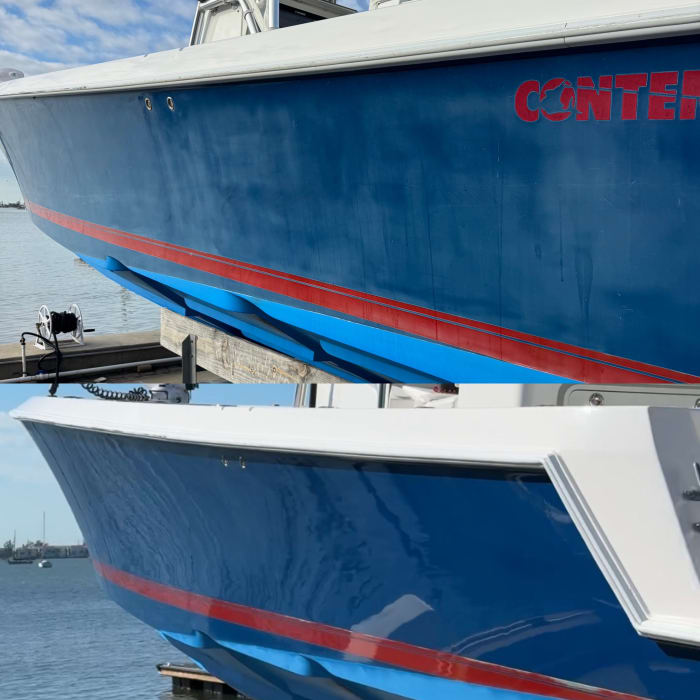
"Our Regal had been sitting in a Clearwater Beach slip for two seasons without any professional work and was totally oxidized. Alex came to the dock, wet-sanded the whole hull, and the result was unbelievable. Color fully restored."